
The decision that quietly shapes everything
Ask an ABA clinic owner about their biggest operational risks and they will usually name staffing, reimbursement, or compliance. Few will name the software they run the clinic on. Yet that single choice sits underneath all three. The platform determines how quickly claims go out and how often they come back denied, how much of a clinician’s day disappears into documentation, and whether the clinic can prove medical necessity when an auditor calls.
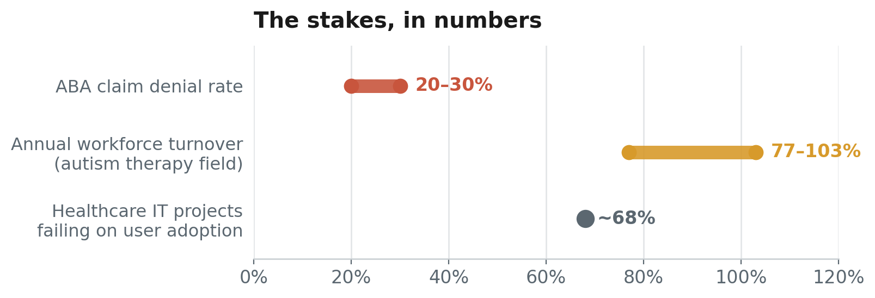
The stakes are not abstract. ABA claim denial rates commonly run in the 20–30% range, well above many other healthcare specialties, and most of those denials trace back to authorization lapses and documentation gaps, precisely the failures a clinic’s software is supposed to prevent. Workforce turnover across the autism therapy field runs between roughly 77% and 103% a year, and a meaningful share of that churn is driven by the daily friction of the tools clinicians are forced to use. Meanwhile, industry analysts increasingly describe software selection as the choice of a long-term operational partner rather than a product.
And yet the way most owners make that choice almost guarantees they will get it wrong.
The checklist trap
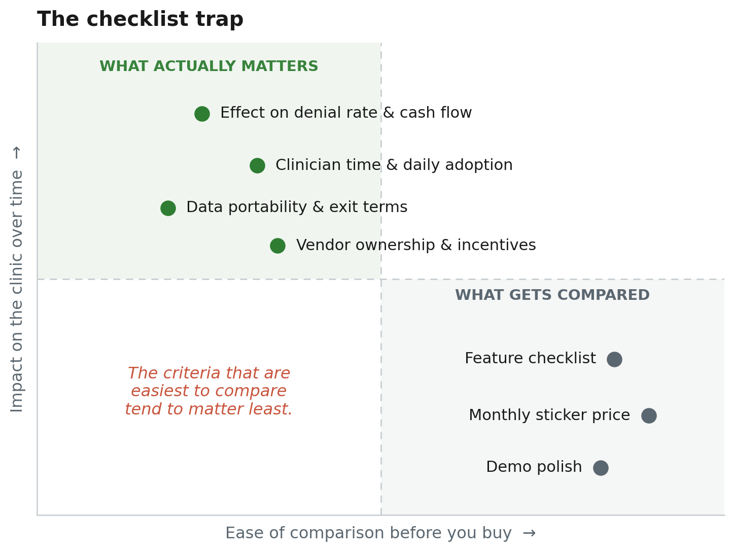
Walk through any “how to choose ABA software” guide and you will find the same advice: compare features, confirm HIPAA compliance, check that it handles your CPT codes, make sure it scales, and weigh the monthly price. All sensible. All necessary. And all close to useless as the basis for the actual decision.
The problem is that feature checklists describe what every serious platform already claims to do. When a dozen vendors all tick the same boxes (scheduling, data collection, 837 claim submission, EVV, telehealth, audit trails), the checklist stops discriminating between them. Owners are left comparing products that look identical on paper, then breaking the tie on price or on whoever gave the most polished demo. Neither is a reliable predictor of how the system will perform in their clinic eighteen months later.
This is the checklist trap: the criteria that are easiest to compare are the ones that matter least, and the criteria that matter most are the hardest to see before you have committed.
What is actually being decided
My doctoral research examined how technology leaders shape the buying decisions of the organizations they serve. The central finding, grounded in resource-based view theory, was that durable competitive value comes not from any single feature but from resources that are valuable, rare, and hard to imitate, and that the buyers who choose well are those who learn to evaluate those resources rather than the surface features.
Applied to ABA software, this reframes the decision entirely. An owner is not buying a feature set. They are acquiring a set of capabilities that will either compound in their favor over years or quietly erode their margins. The relevant question is not “does it have X?” but “what does this choice do to my cost structure, my clinicians’ time, my audit posture, and my freedom to leave, over the life of the relationship?”
Seen this way, the software decision is a strategic resource decision. The owners who treat it as a procurement exercise (lowest price that checks the boxes) are optimizing the wrong variable.
Why good owners still get it wrong
Intelligent, experienced operators make poor software choices for reasons documented across decades of buyer-behavior research. Five failure modes show up repeatedly in this market.
Price and feature anchoring. Faced with hard-to-compare options, buyers anchor on the numbers they can compare: monthly cost and feature counts. A platform that costs ten dollars less per user but quietly raises the denial rate by a few points will cost far more than it saves, but that arithmetic never appears on the comparison sheet.
The demo illusion. Demos are built to show a system at its best, on clean data, run by someone who knows every shortcut. They reveal almost nothing about how the platform behaves on a Tuesday afternoon when a behavior technician is logging a session from a parking lot on a phone. Roughly two-thirds of healthcare software implementations are reported to fail on user adoption, not on features, a gap a demo is structurally incapable of exposing.
Information asymmetry. The vendor knows where the system is weak; the buyer does not. Absent credible, neutral education, owners fill the gap with vendor marketing and peer anecdote. My research found that this is exactly where trust is won or lost: the leaders who most influence buying decisions are the ones who educate buyers honestly (including about trade-offs and limitations) rather than the ones who pitch hardest.
Underweighting the exit. Most negotiations focus on go-live and price. But the largest financial risk in a software relationship usually appears at renewal or exit: in high data-export fees, weak extract timelines, and proprietary formats that make leaving expensive. Owners who do not negotiate data portability and exit terms at the start are, in effect, signing a contract whose worst clause they have not read.
Ignoring the vendor’s incentives. Over the past several years, private equity has consolidated much of the behavioral health software landscape; the company that built a platform is often no longer the company that owns it. A financial sponsor’s obligations run to its investors, which can reshape pricing, support, and roadmap in ways that have nothing to do with a clinic’s needs. Owners rarely ask who owns their vendor and what that owner is optimizing for, yet it may matter more than any feature.
A better way to decide
If features are table stakes, what should an owner actually evaluate? Start with the cost that never appears on the comparison sheet.
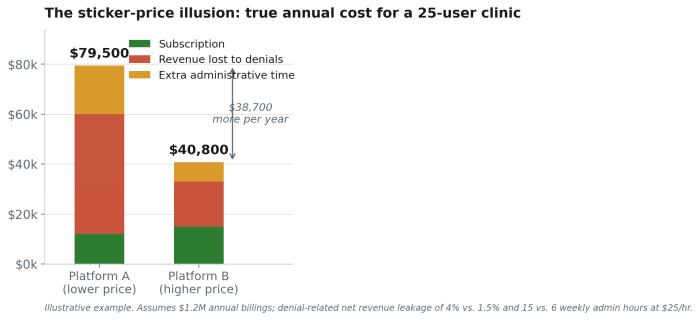
The chart makes the point: a platform with the lower subscription can be the more expensive choice once its effect on denials and administrative load is counted. Five questions cut closer to the truth than any feature list.
What is the total operational cost, not the sticker price? Model the platform’s effect on denial rate, days-to-payment, and administrative hours per week, then multiply across a year. A modest difference in clean-claim rate dwarfs any plausible difference in subscription price.
Where does the clinician’s time go? Put a real behavior technician and a real BCBA in front of the system with real workflows. Count the clicks to document a session and the steps to tie a note to an authorization. The platform that protects clinical time is also the platform that protects retention.
Can I get my data out quickly, completely, and in a usable form? Insist on written export rights covering clinical notes, scheduling, claims, remittances, and audit logs, in standards-based formats, with defined timelines and no punitive fees. The ease of leaving is the truest measure of how a vendor will treat you while you stay.
Who owns this company, and what are they optimizing for? Ask directly. A stable, mission-aligned owner and an independent product roadmap are resources in their own right. Ownership structure belongs on the evaluation sheet, right next to features.
Does the vendor educate me or sell to me? This is the trust test. A vendor willing to tell you where their product is not the right fit (and to teach you how to evaluate the whole category, not just their tool) is signaling the kind of partnership that survives contact with reality. The pitch that has no weaknesses is the one to distrust.
Table 1. Reframing the five questions that decide well.
What most owners ask | What the best owners ask | Why it matters |
|---|---|---|
“How much per user?” | What is the total operational cost: denials, days-to-payment, and admin hours? | A few points of denial rate dwarf any subscription difference. |
“Does it have the features?” | Where does my clinician’s time actually go in this system? | Workflow friction is a hidden driver of burnout and turnover. |
“Is it HIPAA-compliant?” | Can I get all my data out quickly, completely, and in standard formats? | Exit terms are the truest test of how a vendor treats you. |
“Is the price locked in?” | Who owns this vendor, and what are they optimizing for? | Ownership shapes pricing, support, and roadmap. |
“How good is the demo?” | Will this vendor educate me, or sell to me? | The pitch with no weaknesses is the one to distrust. |
The owners who win
The clinics that thrive through rate pressure, audits, and consolidation will not be the ones that found the cheapest platform with the longest feature list. They will be the ones whose owners learned to see past the checklist to the resources underneath, and who chose a partner that made them better at deciding, not just easier to close.
That is the deeper lesson of how buying decisions get made. The most influential technology leaders do not win by out-pitching their competitors. They win by educating their customers so well that the customer makes a good decision, and remembers who helped them make it. For ABA owners on the buying side, the reciprocal is simple: choose the vendor who treats your decision as something to be informed, not merely won.
Magnus Ekwunife, DBA, is co-founder of HarmonyKloud. A SAFe Practice Consultant with 25+ years leading enterprise technology delivery, he is also adjunct faculty teaching project management, Agile, and technology innovation. His doctoral research at Walden University examined how technology leaders shape the buying decisions of the organizations they serve.
References
1. MedCloudMD. (2026). ABA Billing Guidelines for 2026: CPT, ICD-10 & CMS Rules. https://www.medcloudmd.com/post/aba-billing-guidelines-2026
2. Caretap. (2026). Top Reasons ABA Claims Get Denied and How to Prevent Them in 2026. https://caretap.net/blog/top-reasons-aba-claims-get-denied-how-prevent-them-2026/
3. VGSoft. (2026). State of ABA Therapy 2026: Industry Report for Practice Owners. https://vgsoft.co/blog/state-of-aba-therapy
4. Behavioral Health Business. (2026). Strained, Misunderstood, Unprepared: The State of the Autism Therapy Workforce in 2026. https://bhbusiness.com/2026/05/26/strained-misunderstood-unprepared-the-state-of-the-autism-therapy-workforce-in-2026/
5. Links ABA. (2025). How to Choose ABA Practice Management Software. https://linksaba.com/how-to-choose-aba-practice-management-software/
6. AlohaABA. (2026). The Ultimate 2026 Guide to ABA Practice Management Software: Features & ROI. https://alohaaba.com/blogs/the-ultimate-guide-to-aba-practice-management-software-streamline-your-therapy-business
7. BioPharma APAC. (2026). Top 5 ABA Practice Management Software Compared: Features & Pricing (2026). https://biopharmaapac.com/news/70/7657/top-5-aba-practice-management-software-compared-features-pricing-2026.html
8. EHR Source. (2026). EHR Data Exit and Vendor Lock-In: Contract Clauses That Actually Work. https://www.ehrsource.com/articles/ehr-data-exit-and-vendor-lock-in-contract-clauses/
9. EHR Source. (2026). Private Equity Is Reshaping Behavioral Health EHR: What Providers Need to Know. https://www.ehrsource.com/articles/behavioral-health-ehr-acquisitions/