The plan was never the problem
Walk into most strategy reviews and you find good thinking. The market analysis is rigorous, the priorities are defensible, and the leadership team is aligned. Then six months later, very little has changed. This is the strategy-to-execution gap, the distance between what an organization decides and what its people actually do, and it is where most strategies quietly fail.
The numbers are sobering and remarkably consistent. Harvard Business Review research puts the failure rate of well-formulated strategies at around sixty-seven percent, almost always in execution rather than design. Kaplan and Norton, whose Balanced Scorecard shaped how organizations measure performance for three decades, estimated that up to ninety percent of strategies are never executed successfully. McKinsey research finds that roughly seventy percent of transformations fall short of their goals, most often in execution rather than design. The plan was right. The execution was absent.
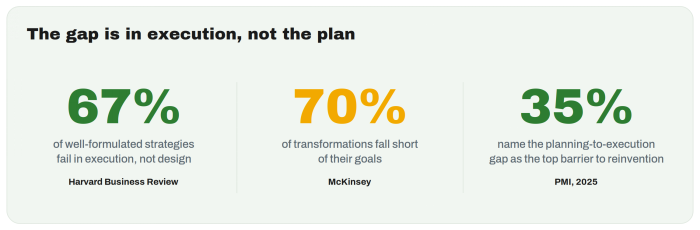
Figure 1. Across HBR, McKinsey, and PMI research, the failure sits in execution, not the plan.
The cost is not abstract. Companies with poor execution forfeit close to forty percent of their strategy’s potential value, and fewer than half of employees can even name their organization’s top strategic priorities. A strategy that never reaches the people doing the work is an expensive document, and nothing more.
AI speed turns a chronic gap into an acute one
This gap has always been costly. What has changed is the time available to close it. A recent Project Management Institute study of senior executives found that ninety-three percent believe they must rethink their business model at least every five years, and nearly two-thirds must do so every two years or more. The single barrier they named most often, ahead of capital, talent, and technology, was the disconnect between planning and execution.
In that same study, only half of projects met a modern definition of success. Thirteen percent failed outright and another thirty-seven percent only partially delivered. When a market re-prices every quarter, a strategy that takes a year to travel from the boardroom to the front line is obsolete before it arrives. Speed of execution has become part of the strategy itself, and the annual cascade cannot keep pace.
So the unit of strategy moves to the team
The resolution is structural, not motivational. You do not close the gap by writing a better plan or running another offsite. You close it by shortening the distance between deciding and doing, which means pushing strategy down to the place that is already closest to the customer and the solution: the empowered team.
In that model, strategy stops being a document handed down once a year. It becomes a loop, run continuously by the team. The team inspects and adapts to the market, translates what it learns into solutions that fit the customer’s world, delivers with product alignment, and feeds the result back into strategy. The team is not the recipient of strategy. It is where strategy is executed, tested, and either won or lost.
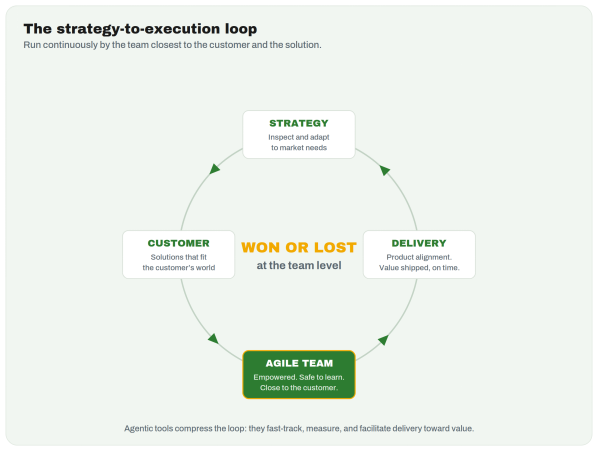
Figure 2. Strategy as a continuous loop, run by the empowered team closest to the customer and the solution.
This is the shift my earlier piece on the Agile Manifesto pointed toward. When AI absorbs the mechanical half of the work, what remains is the human half: judgment, customer intimacy, and the speed to learn. The loop above is where that human half does its work.
What an empowered team is, and what it is not
The word empowered is overused, so it is worth being precise. Marty Cagan, whose work at the Silicon Valley Product Group has documented how the strongest product organizations operate, draws a sharp line. A feature team is an order-taking team. It is handed a roadmap, told to build it, and measured on delivery. An empowered team is given a problem, the business context behind it, and the autonomy to find the best solution, and it is held accountable for the outcome rather than the output.
That distinction is the whole game. An order-taking team can only execute the plan it was given, at the speed it was given. An empowered team can move the strategy, because it is close enough to the customer to see what the plan missed, and trusted enough to act on it. As Cagan puts it, autonomy is meaningless without accountability. The two travel together, and both require something many organizations find hard: executives willing to extend real trust to a team.
The conditions that let a team carry strategy
Empowerment is necessary, but it is not sufficient. A team carries strategy well only when a specific set of conditions is in place. These are the ones that matter most, drawn from the field and from building under real constraints.
A product owner who embodies the customer and the solution. Not a backlog administrator who grooms tickets, but someone who carries the customer’s daily reality and the problem space so completely that the team builds for a real person rather than a requirement. When the product owner is the customer’s proxy in the room, the team stops guessing.
Real autonomy, paired with real accountability. Give the team the problem and the business context, not the feature list, and hold it to a measurable outcome. Autonomy without accountability drifts. Accountability without autonomy suffocates. Strong teams are built on both.
Psychological safety. Amy Edmondson’s research, later echoed by Google’s study of its own teams, found that the strongest single predictor of high-performing teams is psychological safety: the confidence to admit that a task is stuck, an estimate was wrong, or an idea failed, without penalty. Without it, inspect-and-adapt becomes theater, and the team hides the very information that strategy depends on.
Proximity to the customer. The team must sit close enough to the customer to run short feedback loops, experiment, and adapt to evolving, prioritized needs rather than a frozen roadmap. Distance from the customer is distance from the truth.
Clear strategic context. Autonomy only points in the right direction when the team knows the few priorities that matter and the reasoning behind them. Given that fewer than half of employees can name their top priorities, this is where most alignment quietly breaks. Aligned intent, not detailed instruction, is what lets a team move fast without moving apart.
Agentic tooling that compresses the loop. Modern AI agents can fast-track the scaffolding, measure progress toward value, and facilitate delivery, so a small empowered team now moves at a speed that recently required a large one. Used well, the tools hand the team back the hours to spend on judgment and on the customer.
What AI changes, and what it does not
The temptation is to treat agentic AI as the answer by itself. It is not. AI is a multiplier, and a multiplier only pays off on what it multiplies. Point it at an order-taking team and you produce the wrong things faster. Point it at an empowered team that sits close to the customer and is safe enough to learn, and you compress the distance between strategy and execution toward zero.
This is the same lesson the Agile Manifesto teaches at twenty-five. The technology raises the ceiling. The team operating model decides whether you reach it. Agentic tools fast-track the build, measure the progress, and facilitate the delivery, but they do not supply the judgment about what is worth building, and they do not create the trust that lets a team move at speed. Those remain human, and they remain the constraint.
What building one taught me
I have watched this play out while building HarmonyKloud, an all-in-one platform for behavioral health practitioners. The strategy only ever moved as fast as the team closest to the clinicians. A product owner who carried the clinician’s daily reality, rather than a list of features. A team empowered to adapt to what practitioners actually needed as we learned it, rather than to a roadmap fixed months earlier. Agentic tooling to fast-track the scaffolding and measure progress toward real value.
The honest lesson is in where the wins and the misses happened. They happened at the team level, not in the strategy deck. When we stayed close to the customer and safe to learn, the loop turned quickly and the strategy advanced. When we drifted from the customer or slowed the feedback, no amount of planning rescued it. The plan was never the variable. The team running the loop was.
Build the team, not just the plan
The strategy-to-execution gap will not be closed by a better plan. It is closed by a better team operating model: empowered teams, close to the customer, safe to learn, aligned on the few priorities that matter, and amplified by agentic tools. In a market moving at AI speed, the plan is the easy part. The advantage belongs to whoever can execute it, learn, and adapt faster than the market changes.
That happens at the team level. So the question for leaders is no longer only what the strategy is. It is whether the teams can run the loop fast enough to win with it. Build the team that can run the loop, and the strategy will follow.
Magnus Ekwunife, DBA, is co-founder of HarmonyKloud. A SAFe Practice Consultant with 25+ years leading enterprise technology delivery, he is also adjunct faculty teaching project management, Agile, and technology innovation. His doctoral research examined how technology leaders shape the strategic decisions of the organizations they serve.
References
1. Sull, D., Homkes, R., & Sull, C. (2015). Why Strategy Execution Unravels, and What to Do About It. Harvard Business Review. https://hbr.org/2015/03/why-strategy-execution-unravelsand-what-to-do-about-it
2. Kaplan, R. S., & Norton, D. P. The Balanced Scorecard: research on strategy execution and measurement.
3. McKinsey & Company. Research on transformations falling short of their goals.
4. Project Management Institute. (2025). Step Up: Redefining the Path to Project Success with M.O.R.E. https://www.pmi.org/about/press-media/2025/new-pmi-research-reveals-strategy-execution-gap-is-undermining-transformation-and-how-to-close-it
5. Cagan, M. (2024). Transformed: Moving to the Product Operating Model. Silicon Valley Product Group. https://www.svpg.com/empowered-product-teams/
6. Edmondson, A. C. The Fearless Organization (psychological safety); and Google re:Work, Project Aristotle.
7. Gartner. Research on strategy execution and employees’ awareness of top strategic priorities.